
Protein calculator
Protein calculator for muscle building and weight loss
Enter your weight to see a daily protein range. The result shows the multiplication and source context, so you can understand the estimate instead of treating it as an exact personal requirement.
Calculate a daily range
For adults without a medically prescribed protein target. Weight is used for an educational estimate, not to assess whether a goal is suitable.
Example: 70 kg · exercise context
98–140 g protein per day
70 kg × 1.4–2.0 g/kg/day. Select Calculate to update this example.
Which range is used?
| Context | Range used | How to interpret it |
|---|---|---|
| Exercise and muscle building | 1.4–2.0 g/kg/day | ISSN’s general range for healthy exercising people |
| Weight-loss planning | 1.2–1.6 g/kg/day | A range discussed in a weight-management research review |
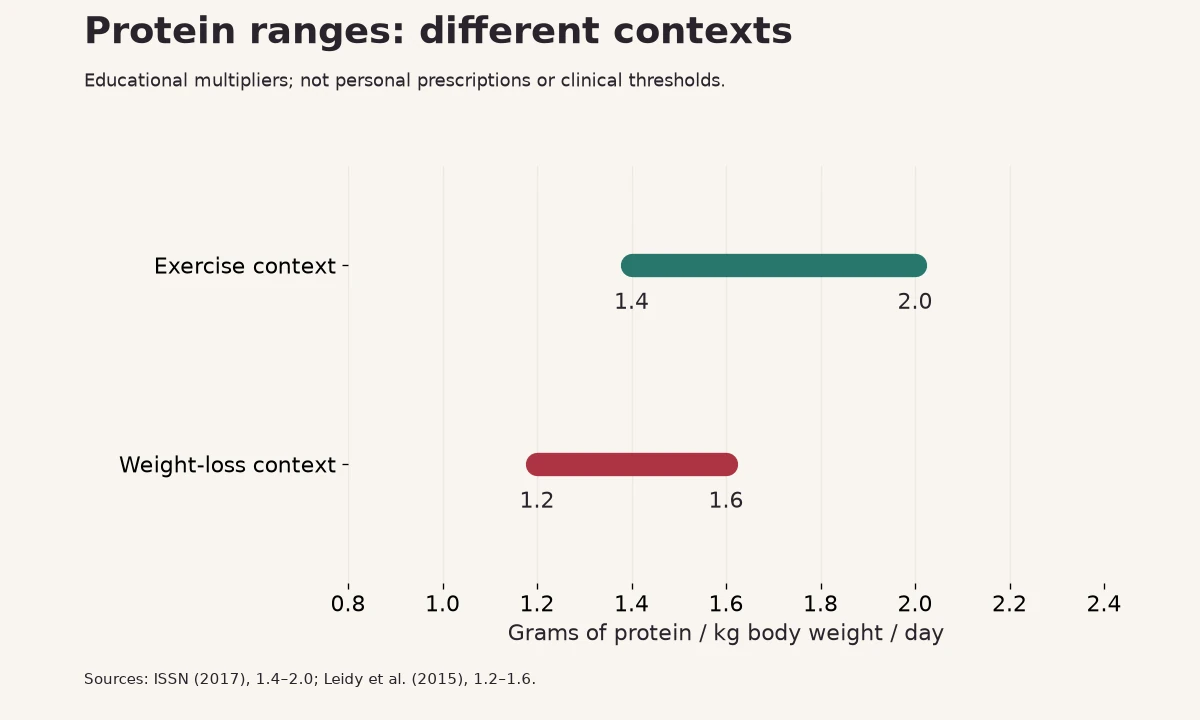
The exercise range comes from an ISSN position stand. The weight-loss range comes from a review of higher-protein diets, whose longer-term findings and adherence varied. A lifter dieting for competition, or anyone with a medically managed diet, may need different guidance. This simple tool does not estimate lean mass or prescribe an energy deficit.
How the calculation works
Multiply body weight in kilograms by each end of the chosen range. For pounds, first multiply by 0.45359237 to convert to kilograms. Results are rounded to whole grams for display; decimals would suggest more personal precision than the method supports.
At 70 kg, the exercise example is 70 × 1.4 = 98 g and 70 × 2.0 = 140 g. The weight-loss example is 70 × 1.2 = 84 g and 70 × 1.6 = 112 g. These are alternative contexts, not amounts to add together.
| Example body weight | Exercise range | Weight-loss range |
|---|---|---|
| 50 kg / about 110 lb | 70–100 g/day | 60–80 g/day |
| 70 kg / about 154 lb | 98–140 g/day | 84–112 g/day |
| 90 kg / about 198 lb | 126–180 g/day | 108–144 g/day |
Turn a range into foods you can log
Review the protein in meals you already eat before buying supplements or changing every recipe. Weigh a familiar portion and check its food entry. Cooked and dry weights, brands and recipes can differ. A plan based on an incorrect serving is still incorrect even if the calculator multiplication is right.
For a worked food example, 100 g of plain paneer contains about 18.9 g protein in the cited reference. A 50 g portion provides about half that amount. The article explains why packaged labels and different cheeses can differ. Use the same serving checks for tofu, yogurt, eggs, beans, fish or other foods in your routine.
What the calculator cannot tell you
Weight and a selected context cannot establish your health status, dietary quality or optimal target. The tool does not account for pregnancy, age-related clinical needs, kidney disease, a prescribed diet, unusual body composition or specialist athletic cuts. Get qualified individual advice when those factors matter.
It does not promise weight loss or muscle growth. Training, total energy intake, sleep, food preferences and a manageable routine all matter. Choosing the top of a range does not automatically make a plan better.
Privacy and using the result
The calculation runs in this page and does not submit your weight, units or selection to the server, save them in browser storage, or place them in a URL. The site’s usual page-level behavior is described in its privacy policy. Closing or reloading this page restores the example.
Use the estimate as a discussion or planning starting point. To keep a daily food log, compare the workflows in MyFitnessPal alternatives. For training, start with a consistent programme and a useful progression log rather than adjusting protein in response to every workout.
Questions
Does this calculator work in pounds?
Yes. It converts pounds to kilograms before applying the same multipliers. Switching units preserves approximately the same entered body weight.
Why is there a range instead of one target?
The sources discuss groups and contexts. Weight alone cannot identify your exact personal requirement.
Is the weight-loss range a calorie prescription?
No. It is a protein planning example and does not calculate energy needs, a deficit or whether losing weight is appropriate.
Is my weight saved?
No. This tool calculates locally without transmitting or storing its input.