
Food and protein
Paneer protein per 100 g: calories, portions and comparisons
Plain paneer has about 18.9 g protein and 258 kcal per 100 g in the Indian Food Composition Tables. Paneer is a fresh, unaged cheese used in South Asian cooking; the nutrition of your packaged product may differ.
Paneer nutrition per 100 g
| Paneer (100 g) | Calories | Protein | Fat | Carbs |
|---|---|---|---|---|
| Paneer (IFCT 2017) | 258 kcal | 18.9 g | 14.8 g | 12.4 g |
Home-made paneer varies with the milk and how firmly it’s pressed: full-fat buffalo milk gives a richer, higher-calorie paneer than toned cow’s milk. If you buy a brand, the pack label is the most accurate number for that paneer.
Protein in a cube, a serving and a pack
| Amount | Protein | Calories |
|---|---|---|
| 1 cube (about 20 g) | 3.8 g | 52 kcal |
| 50 g (a small serving) | 9.5 g | 129 kcal |
| 100 g | 18.9 g | 258 kcal |
| 200 g (a pack) | 37.8 g | 516 kcal |
Values from IFCT 2017.
Paneer vs tofu, eggs and Greek yogurt
Compare the actual product and preparation. These examples are per 100 g: plain paneer (IFCT L003) and specific USDA foods, not every brand of tofu or yogurt.
| Food (100 g) | Protein | Calories | Protein per 100 kcal |
|---|---|---|---|
| Paneer, plain (IFCT L003) | 18.86 g | 258 kcal | 7.3 g |
| Egg, whole, hard-boiled (USDA 173424) | 12.58 g | 155 kcal | 8.1 g |
| Greek yogurt, plain, nonfat (USDA 170894) | 10.19 g | 59 kcal | 17.3 g |
| Tofu, firm, calcium sulfate and nigari (USDA 172448) | 9.04 g | 78 kcal | 11.6 g |
| Yogurt, plain, whole milk (USDA 171284) | 3.47 g | 61 kcal | 5.7 g |
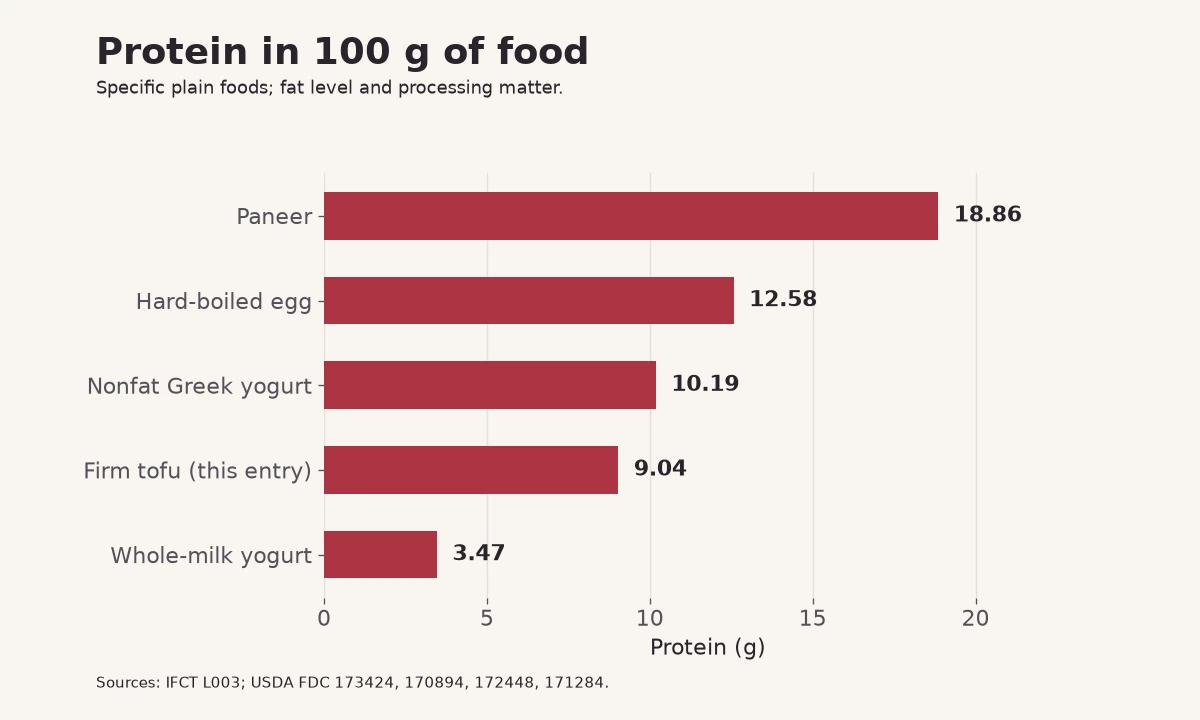
Firm tofu can vary substantially with water content and processing. A higher-protein tofu pack may exceed this USDA example. Greek yogurt and hung curd also vary: straining time and added cream matter.
How much protein do you need?
ICMR-NIN’s recommended dietary allowance for healthy Indian adults is 0.83 g of protein per kg of body weight a day: about 54 g for a 65 kg man and 46 g for a 55 kg woman. That is the amount to avoid falling short, not the amount for building muscle.
If you lift weights, research suggests more helps: a 2018 meta-analysis found gains in muscle levelled off at about 1.6 g per kg a day, and the International Society of Sports Nutrition suggests 1.4 to 2.0 g per kg for people who train. For a 70 kg person, that is roughly 110 g a day.
Getting there as a vegetarian
- Spread it out. About 25 to 35 g at each of three or four meals is easier than one big serving.
- Mix sources. Paneer, hung curd, milk, soya, dals and eggs if you eat them. Pulses and cereals together (dal and rice, rajma and roti) complement each other’s amino acids.
- Watch the fat. If you’re eating less to lose fat, swap some paneer for low-fat paneer, tofu, soya chunks or hung curd, which give the same protein for fewer calories.
Buying and measuring paneer outside India
Look for paneer in South Asian groceries, international supermarkets or the chilled cheese aisle. Paneer and Western cottage cheese are different products: cottage cheese usually has loose curds and more moisture, so do not reuse its label for paneer. Halloumi and feta are different again.
100 g is about 3.5 oz; 200 g is about 7.1 oz. These are rounded mass conversions, not fixed numbers of cubes. For a curry, log the paneer plus sauce, oil and other ingredients, rather than using plain paneer nutrition for the whole dish.
For a label written per serving, multiply the protein by 100 and divide by the serving weight in grams. A 50 g serving with 10 g protein works out to 20 g per 100 g. That is a calculation example, not a claim about a brand.
Tracking it
Bodyvault’s food database has paneer from IFCT and paneer dishes from the Indian Nutrient Databank, and sets a protein target from your weight, goal and training. When you’re behind in the evening, it suggests dishes that close the gap.
Questions
How much protein is in 100 g of paneer?
About 18.9 g protein and 258 kcal per 100 g of plain paneer (IFCT L003). Check the package label for your own brand and fat level.
How much protein is in 200 g of paneer?
About 37.7 g protein and 516 kcal for 200 g of the IFCT plain-paneer reference. A commercial pack can differ.
Is paneer better than eggs for protein?
Paneer has more protein per 100 g than the USDA hard-boiled egg example (18.86 g versus 12.58 g), but the egg has fewer calories (155 versus 258 kcal). Choose the food and serving that fit your preferences.
Is paneer good for weight loss?
It’s filling and high in protein, but at 258 kcal per 100 g it’s easy to eat a lot of calories. Weigh it, or choose low-fat paneer, tofu or hung curd on days you want fewer calories.
Is paneer the same as cottage cheese?
Paneer is pressed fresh cheese. Western cottage cheese has loose curds and a different water and fat content. Use the nutrition label for the product you actually eat.
Is paneer or tofu higher in protein?
The IFCT plain paneer reference has 18.86 g per 100 g. The USDA firm tofu example in this guide has 9.04 g, but other tofu products can be much higher. Check both labels.
Sources
- Longvah T et al. (2017). Indian Food Composition Tables. ICMR-National Institute of Nutrition, Hyderabad.
- U.S. Department of Agriculture, FoodData Central.
- Indian Nutrient Databank (INDB), 2024 release (Vijayakumar A, Jaacks LM et al.).
- ICMR-NIN (2020). A brief note on Nutrient Requirements for Indians: Recommended Dietary Allowances and Estimated Average Requirements.
- Morton RW et al. (2018). A systematic review, meta-analysis and meta-regression of the effect of protein supplementation on resistance training-induced gains in muscle mass and strength in healthy adults. Br J Sports Med 52(6):376–384.
- Jäger R et al. (2017). International Society of Sports Nutrition Position Stand: protein and exercise. J Int Soc Sports Nutr 14:20.
- USDA: whole hard-boiled egg, FDC 173424.
- USDA: nonfat plain Greek yogurt, FDC 170894.
- USDA: firm tofu with calcium sulfate and nigari, FDC 172448.
- USDA: whole-milk plain yogurt, FDC 171284.
General information about fitness and nutrition, not medical advice. If you have a health condition, are pregnant or take medication, talk to your doctor before changing your diet or training.