
Food and protein
Navratri fasting food: calories and protein in vrat food
A 150 g bowl of sabudana khichdi has about 281 kcal and 4.1 g protein in the INDB reference recipe. Navratri fasting foods can fit a balanced diet, but the recipe, oil and portions matter. This guide uses weighed examples for people observing vrat anywhere in the world.
Calories in common vrat foods
Per usual serving, from India’s food tables (IFCT 2017 and the Indian Nutrient Databank) and USDA FoodData Central:
| Food | Serving | Calories | Protein | Carbs | Fat |
|---|---|---|---|---|---|
| Sabudana khichdi | 1 katori (150 g) | 280 kcal | 4.1 g | 33.6 g | 15.1 g |
| Rajgira (amaranth) ladoo | 1 ladoo (44 g) | 199 kcal | 4.4 g | 22.5 g | 10.0 g |
| Makhana kheer | 1 katori (150 g) | 162 kcal | 4.9 g | 19.4 g | 7.5 g |
| Sweet potato, raw | 100 g | 109 kcal | 1.3 g | 24.3 g | 0.3 g |
| Banana | 1 banana (118 g) | 124 kcal | 1.4 g | 27.8 g | 0.4 g |
| Curd, whole milk | 1 katori (150 g) | 92 kcal | 5.2 g | 7.1 g | 4.9 g |
| Peanuts, raw | 1 handful (30 g) | 170 kcal | 7.7 g | 4.8 g | 14.8 g |
Vrat flours and grains, per 100 g
| Ingredient (100 g, dry) | Calories | Protein | Fibre |
|---|---|---|---|
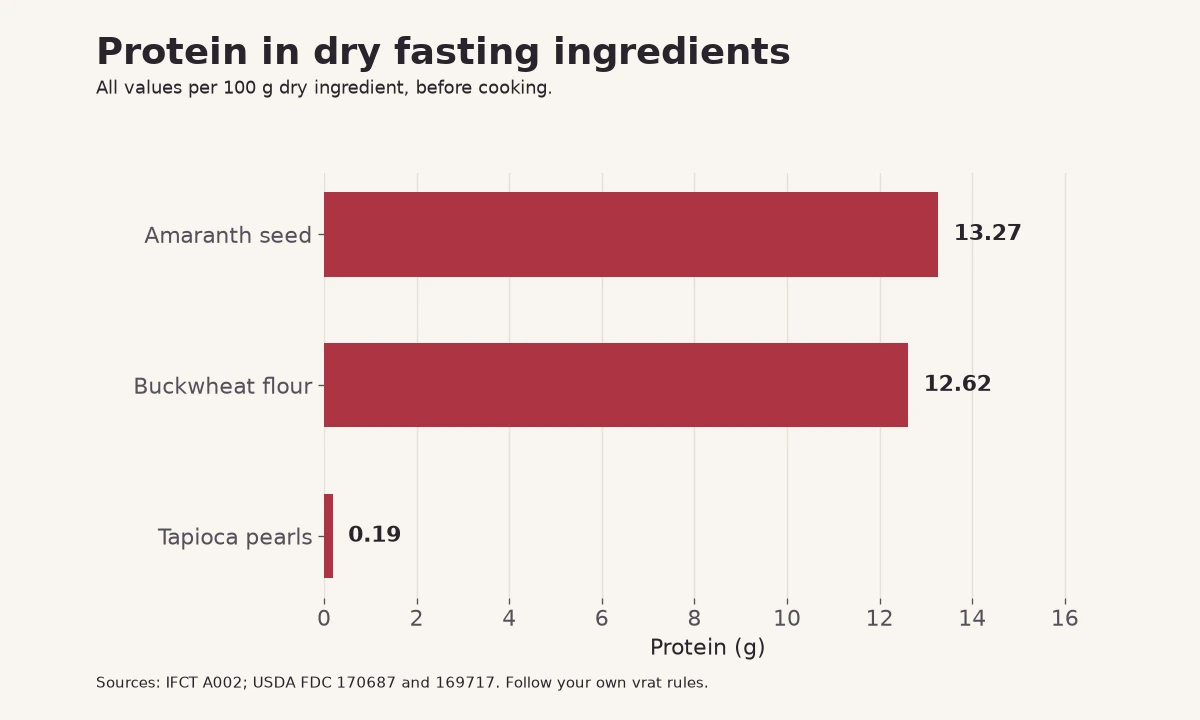
| Rajgira (amaranth seed) | 356 kcal | 13.3–14.6 g | 7.0–7.5 g |
| Kuttu (buckwheat flour) | 335 kcal | 12.6 g | 10.0 g |
| Sabudana (tapioca pearls) | 358 kcal | 0.2 g | 0.9 g |
| Singhara (water chestnut, fresh) | 96 kcal | 0.9 g | 3.0 g |
The difference is striking: rajgira and kuttu have real protein and fibre; sabudana is almost pure starch, with practically no protein. A day built on sabudana khichdi and fried snacks can leave you well short of protein.
A Navratri food list is not one rulebook
Vrat means a religious fast. Foods permitted during Navratri differ by family and tradition; this article describes nutrition rather than deciding what you may eat. Some people include dairy, nuts, fruit, certain flours and tubers. Confirm the choices with your own practice.
Outside India, kuttu may be sold as buckwheat, rajgira as amaranth, and sabudana as tapioca or sago pearls. Read the ingredients: blended buckwheat flour can include wheat, and products sold as sago or tapioca are not always identical. Fresh water chestnut and dried singhara flour are different foods; the fresh entry above is not a flour value.
Here a katori is a small bowl estimated at 150 g, about 5.3 oz. Weigh your usual bowl once. A handful is only an example; peanuts add both protein and energy, and a large handful can be much heavier than 30 g.
Keeping protein up during the fast
If you eat dairy during your vrat, protein is easy to keep up:
- Curd and paneer. A katori of curd gives about 5 g; 100 g of paneer about 19 g. See protein in paneer.
- Milk gives about 3.3 g per 100 ml (IFCT, cow’s milk), so a glass has about 8 g.
- Rajgira and kuttu instead of sabudana for rotis, cheela or porridge.
- Peanuts and makhana as snacks, in place of fried chips.
Build a meal around your allowed foods
| Meal component | Examples if allowed | What it contributes |
|---|---|---|
| Protein source | Paneer, plain yogurt or milk | Protein alongside the grain or tuber |
| Starchy food | Buckwheat roti, amaranth or sweet potato | Energy; weigh the finished portion |
| Produce | Fruit and vegetables permitted by your tradition | Variety and fibre |
| Added fat | Ghee, oil, nuts and seeds | Count separately; portions change calories |
A dairy-free fast needs a different plan; do not assume substituting a plant drink provides the same protein as milk. Check the label. If your permitted foods make it difficult to meet your needs, adjust training expectations and seek qualified individual guidance.
Training while fasting
If you train during Navratri, keep hard sessions for after a proper meal, drink enough water, and expect a few lower-energy days. A run of short nights from late garba evenings will show in your HRV and recovery too. Bodyvault’s Readiness score takes this into account and tells you when to ease off.
If you have diabetes or another condition, or take medication, talk to your doctor before fasting.
Logging vrat food in Bodyvault
Sabudana khichdi, rajgira ladoo, makhana kheer, kuttu flour, singhara and the other foods above are in the food database. You can also mark days of the week as vegetarian, and meal plans and suggestions on those days leave out meat, fish and eggs.
Questions
How many calories are in sabudana khichdi?
About 280 kcal per 150 g katori, with 15 g of fat and only 4 g of protein (Indian Nutrient Databank).
Which vrat flour has the most protein?
Rajgira (amaranth), at 13 to 15 g per 100 g, closely followed by kuttu (buckwheat) at about 13 g. Sabudana has almost none.
Can I follow this guide outside India?
Yes. Use grams and the English ingredient names, check local product labels, and follow your own fasting tradition. The nutrition calculations do not depend on where you live.
Is fresh singhara the same as singhara flour?
No. Fresh water chestnut contains much more water. The 96 kcal per 100 g figure in this guide is for fresh water chestnut, not dried flour.
Sources
- Indian Nutrient Databank (INDB), 2024 release (Vijayakumar A, Jaacks LM et al.).
- Longvah T et al. (2017). Indian Food Composition Tables. ICMR-National Institute of Nutrition, Hyderabad.
- U.S. Department of Agriculture, FoodData Central.
- USDA: whole-groat buckwheat flour, FDC 170687.
- USDA: dry tapioca pearls, FDC 169717.
- USDA: raw peanuts, FDC 172430.
General information about fitness and nutrition, not medical advice. If you have a health condition, are pregnant or take medication, talk to your doctor before changing your diet or training.