
Recovery and sleep
What is a readiness score, and should you train by it?
A readiness score combines signals such as HRV, resting heart rate, sleep and recent activity into a daily recovery estimate. The scale and algorithm depend on the app: the number is training context, not a medical test or a score you can compare directly across brands.

What goes into it
Most readiness and recovery scores use the same handful of signals from a watch, ring or strap worn to sleep:
- Heart rate variability. A change from your personal baseline can provide recovery context. Apps differ in how heavily they weight it. See HRV by age.
- Resting heart rate. Higher than usual can mean incomplete recovery, illness, alcohol or heat.
- Sleep. How long you slept against what you need, and how regular your sleep has been.
- Breathing rate and skin temperature in sleep, which often rise when you’re getting ill.
- Recent training. Some scores also look at how much you’ve trained lately.
The scales differ. WHOOP’s Recovery runs from 0 to 100%. Bodyvault’s Readiness runs from 0 to 10, with four states: Recover, Pace yourself, Ready and Go for it.
Why it compares you with yourself
A resting heart rate of 60 is great for one person and high for another. Readiness scores avoid this by comparing you with your own baseline, usually the last few weeks or months. Baseline requirements vary by product. Bodyvault needs at least seven nights of HRV and resting-heart-rate history before its first Readiness score. Your score is not directly comparable with a friend’s.
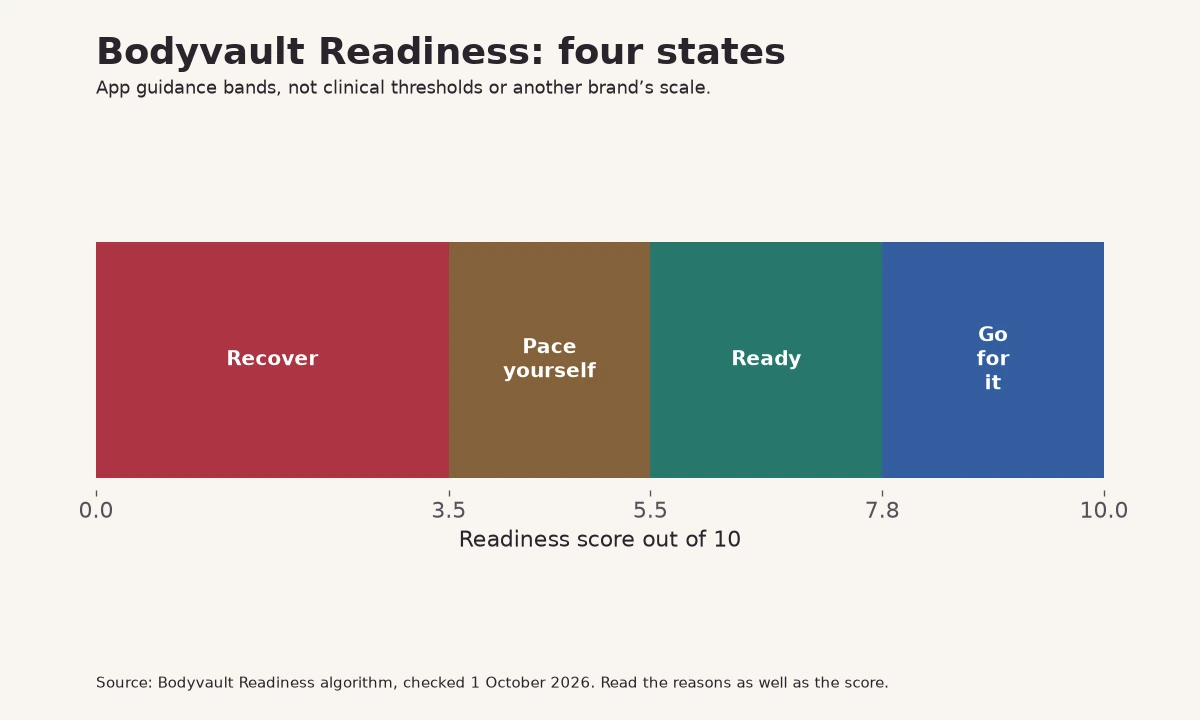
| Bodyvault Readiness / 10 | State | Practical interpretation |
|---|---|---|
| Below 3.5 | Recover | Consider an easier day and review the reasons. |
| 3.5 to below 5.5 | Pace yourself | Reduce extra work if the score and how you feel agree. |
| 5.5 to below 7.8 | Ready | Your usual plan may be appropriate. |
| 7.8 to 10 | Go for it | Consider planned hard work if warm-up and symptoms allow. |
Does training by it work?
There is some good evidence. In a small 2007 trial of 26 healthy, moderately fit men, both the fixed-plan and HRV-guided groups improved maximal running velocity. The HRV-guided group improved more on that measure. That finding supports further study; it does not validate every commercial readiness algorithm or every type of training. Reviews of HRV monitoring in athletes since then support using a rolling average of morning HRV, rather than a single day, to guide training.
The score is a guide, not an order. How you feel, your plans and your goals still count. A low score before a race doesn’t mean don’t race; it means don’t add extra.
Apple Watch readiness and third-party apps
Apple announced its own Readiness feature for Apple Watch Series 12 and Ultra 4 in September 2026. Availability depends on the watch and software. Apple’s score and a third-party app’s score use their own methods, so they can disagree without either number being a direct conversion of the other.
| Product | Score | What to compare |
|---|---|---|
| Bodyvault | Readiness / 10 | Its reasons, data confidence and your own trend |
| Apple Readiness, supported models | Readiness / 10 | Apple’s guidance and eligible device requirements |
| WHOOP | Recovery percentage | WHOOP’s contributors and your own history |
| Other recovery apps | App-specific scale | The app’s stated inputs and baseline rules |
A nutrition app, training log and recovery app solve different problems. Choose the combination that helps you make a useful decision. A full set of numbers is less valuable than a clear explanation of missing data and an action you can follow.
What lowers your score
- A short or broken night.
- Alcohol, especially in the evening.
- A much harder week of training than usual.
- Illness, often a day before you feel it.
- Stress, travel, heat and late meals.
How to use it
- High: a good day for your hardest session or a heavy top set.
- Normal: train as planned.
- Lower: train, but keep a rep or two in reserve and skip extra sets.
- Low: an easy session, a walk or mobility, and prioritise sleep, fluids and food.
- Look at the trend. One low morning can be a real change or measurement noise; repeated changes deserve closer attention.
When your score and how you feel disagree
Check whether sleep was recorded, the watch fit correctly and the latest readings reached your app. Then consider soreness, your recent sessions and your warm-up. Do not repeatedly change devices or breathing routines simply to raise the number.
Fever, chest pain, fainting, or unusual breathlessness take priority over a reassuring wearable score. Persistent unexplained symptoms need medical assessment. A readiness app cannot diagnose illness or rule it out.
Bodyvault’s Readiness
Bodyvault’s Readiness uses HRV, resting heart rate, sleep, temperature and breathing, training load, how you feel and heart-rate recovery, each against your previous 60 nights. Two things are different from most scores:
- It shows its working. Every part is a line with how much it added or took away, and the lines add up to the score.
- It moves through the day. A hard workout takes points; a nap, a proper meal after training and calm time win some back. Each move is listed.
Read how it works on the Readiness score page.
Questions
What is a good readiness score?
In Bodyvault, 5.5 to below 7.8 is Ready, 7.8 to 10 is Go for it, 3.5 to below 5.5 is Pace yourself, and below 3.5 is Recover. These are Bodyvault’s own guidance bands, not universal health thresholds.
Does Apple Watch have a readiness score?
Apple announced Readiness for Apple Watch Series 12 and Ultra 4 in September 2026. Compatibility varies. Apps such as Bodyvault also calculate their own scores from supported Apple Health data.
Why is my readiness low when I feel fine?
Missing or unusual readings, recent training and poor sleep can affect the score. Check its contributors, the data quality and your trend. A low score alone cannot establish illness.
Can I compare my readiness score with WHOOP or Oura?
Use each product’s own trends and explanations. The brands use different inputs, scales and algorithms; a simple multiplication cannot make their scores equivalent.
Does a high readiness score mean I should train harder?
It can support a planned hard day, but goals, symptoms, injury status and warm-up performance still matter. Do not add hard sessions only to use a high number.
Sources
- Kiviniemi AM et al. (2007). Endurance training guided individually by daily heart rate variability measurements. Eur J Appl Physiol 101(6).
- Plews DJ et al. (2013). Training adaptation and heart rate variability in elite endurance athletes: opening the door to effective monitoring. Sports Medicine 43(9).
- Buchheit M (2014). Monitoring training status with HR measures: do all roads lead to Rome? Frontiers in Physiology 5:73.
- WHOOP developer documentation: Recovery.
- Apple: health and fitness announcements, September 2026; Readiness hardware support.
- Bodyvault: Readiness algorithm and score explanation.
General information about fitness and nutrition, not medical advice. If you have a health condition, are pregnant or take medication, talk to your doctor before changing your diet or training.