
Recovery and sleep
HRV by age: what’s a normal heart rate variability?
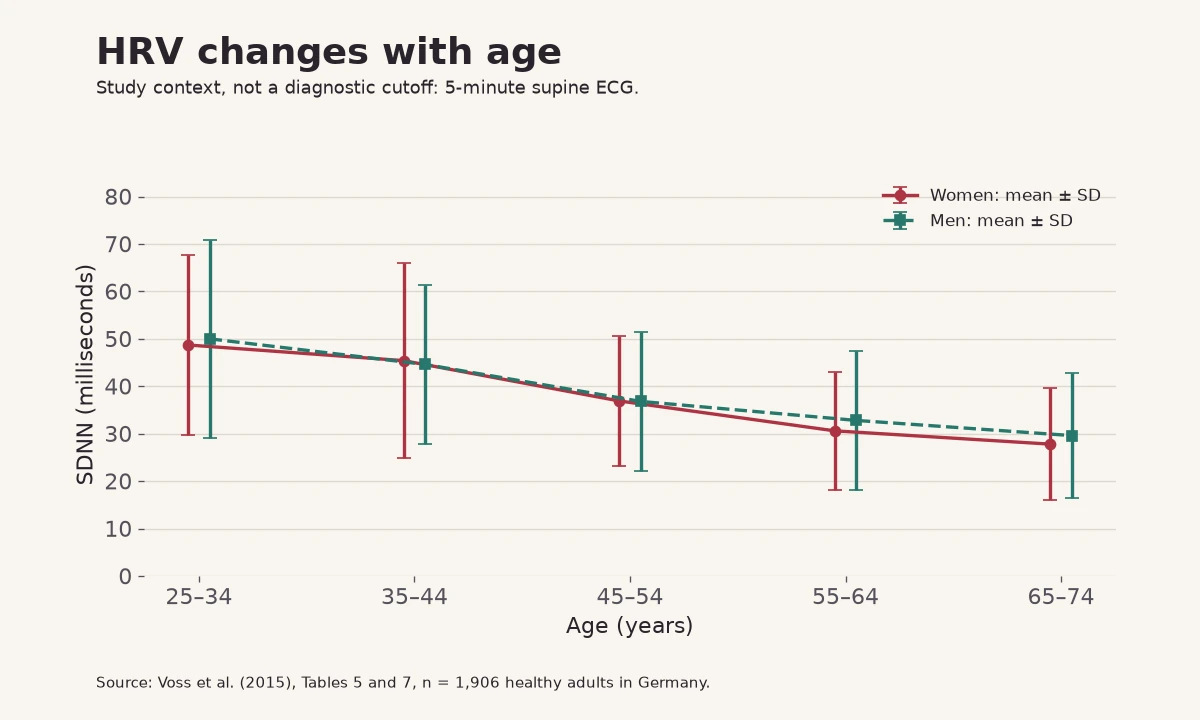
Heart rate variability falls with age. In a study of 1,906 healthy adults, average SDNN fell from about 50 ms at 25 to 34 to under 30 ms at 65 to 74. But the spread between people of the same age is so wide that the most useful number to compare your HRV with is your own.

What HRV is
Your heart doesn’t beat like a metronome. The time between beats changes slightly from beat to beat, and heart rate variability (HRV) measures how much. Some HRV measures reflect activity in the autonomic nervous system, which helps regulate your heartbeat. A consistent personal trend can provide recovery context; a single value does not measure your overall health.
There are two common ways to calculate it, and they give different numbers:
- SDNN: the standard deviation of the time between beats. Apple Watch records HRV this way.
- RMSSD: the root mean square of successive differences, which follows beat-to-beat changes more closely. WHOOP and Oura report it, and Apple Watch also records it on iOS 27 and later.
Because of that, compare SDNN only with SDNN, and RMSSD only with RMSSD.
HRV by age and sex
Voss and colleagues (2015) recorded 5 minutes of ECG lying down in 1,906 healthy adults. Average values (± standard deviation), in milliseconds:
| Age | SDNN, women | SDNN, men | RMSSD, women | RMSSD, men |
|---|---|---|---|---|
| 25–34 | 48.7 ± 19.0 | 50.0 ± 20.9 | 42.9 ± 22.8 | 39.7 ± 19.9 |
| 35–44 | 45.4 ± 20.5 | 44.6 ± 16.8 | 35.4 ± 18.5 | 32.0 ± 16.5 |
| 45–54 | 36.9 ± 13.8 | 36.8 ± 14.6 | 26.3 ± 13.6 | 23.0 ± 10.9 |
| 55–64 | 30.6 ± 12.4 | 32.8 ± 14.7 | 21.4 ± 11.9 | 19.9 ± 11.1 |
| 65–74 | 27.8 ± 11.8 | 29.6 ± 13.2 | 19.1 ± 11.8 | 19.1 ± 10.7 |
A study of 291 healthy Korean adults (Choi and colleagues, 2020), with 5-minute recordings sitting down, found a similar fall in SDNN:
| Age | SDNN, women | SDNN, men |
|---|---|---|
| 20s | 44.5 ± 12.6 | 41.7 ± 11.2 |
| 30s | 34.5 ± 9.4 | 36.6 ± 10.0 |
| 40s | 30.1 ± 10.3 | 30.4 ± 9.8 |
| 50s | 28.6 ± 9.5 | 24.5 ± 9.6 |
| 60s | 22.3 ± 7.6 | 24.7 ± 8.0 |
What is a good HRV for your age?
There is no single pass-or-fail HRV value for everyone of an age. These German and Korean studies describe their selected participants; they do not establish a worldwide diagnostic cutoff. Values from a 5-minute ECG cannot be used as interchangeable norms for short watch samples or an overnight wearable summary.
The ± number is the standard deviation: it describes the spread around a group average. It is not an individual’s safe range, a confidence score for their watch, or a reason to ignore symptoms.
Why your watch’s number won’t match the chart
- Different conditions. These studies measured people lying or sitting still for 5 minutes with an ECG. A watch measures with light through your skin, at different times of day and night, sometimes while you move.
- Night versus day. Sleep stage, breathing, posture and recording duration can change HRV. Compare readings taken in similar conditions.
- The spread is huge. In the Voss study, the standard deviation is about 40% of the average. Two healthy 30-year-olds can have SDNN of 30 and 70 ms.
So a “low” HRV against a chart isn’t a diagnosis, and a “high” one isn’t a prize. What tells you something is a change from your own usual.
Apple Watch, WHOOP, Oura and Garmin: compare the metric
| Before comparing numbers | What to check |
|---|---|
| Metric | SDNN and RMSSD both use milliseconds but calculate different things. |
| Time window | A short spot check, a 5-minute test and an overnight average are different recordings. |
| Conditions | Posture, breathing, sleep stage and movement change the measurement. |
| Device and software | Check the named metric in the app; support can change with hardware and software. |
Apple’s traditional HealthKit HRV type is SDNN. HealthKit also documents RMSSD support. Availability depends on compatible hardware and software; check the actual data type your app uses rather than assuming every Apple Watch reports the same summary.
What moves your HRV
Your HRV drops for a day or more after things that stress your body: a short or poor night, alcohol, illness, a very hard training session, travel and mental stress. Over weeks and months, regular aerobic exercise, good sleep and staying at a healthy weight tend to raise it. Age and genes set much of where your own range sits.
How Bodyvault uses your HRV
Bodyvault builds your own baseline from your previous 60 nights of HRV and compares last night with it. That comparison is the biggest part of your Readiness score. Small changes inside your normal night-to-night swing count for little; a clear drop takes points and the app says so, line by line. Read more about what a readiness score is.
Questions
What is a normal HRV for my age?
For healthy adults measured lying down, average SDNN is about 50 ms at 25 to 34, about 45 ms at 35 to 44, about 37 ms at 45 to 54 and about 30 ms at 55 and over (Voss et al., 2015). The range is wide, so compare your HRV mainly with your own usual.
Is a higher HRV always better?
No. A higher consistent value can be useful recovery context, but unusual jumps, measurement artifacts and differences between metrics can be misleading. Use your trend alongside symptoms and how you feel.
Why is my Apple Watch HRV low?
Check the metric, recording duration, time of day and fit of the watch. Traditional Apple Health HRV uses short SDNN readings, which should not be compared directly with another device’s overnight RMSSD. A low value alone is not a diagnosis.
Does HRV differ between men and women?
In the Voss study, women and men had similar SDNN at most ages, and younger women had slightly higher RMSSD than younger men.
Is 20 ms HRV bad?
Not enough information. Twenty milliseconds means different things for SDNN and RMSSD, different recording windows and different personal baselines. Persistent concerns or symptoms need clinical assessment, not a chart verdict.
Should I compare sleeping HRV with this chart?
This chart uses 5-minute ECG recordings while lying awake at rest. Overnight wearable summaries have different measurement conditions and are not interchangeable with these study means.
Sources
- Voss A et al. (2015). Short-term heart rate variability: influence of gender and age in healthy subjects. PLoS ONE 10(3): e0118308.
- Choi J, Cha W, Park MG (2020). Declining trends of heart rate variability according to aging in healthy Asian adults. Frontiers in Aging Neuroscience 12.
- Shaffer F, Ginsberg JP (2017). An overview of heart rate variability metrics and norms. Frontiers in Public Health 5:258.
- Apple: heart-rate measurement and SDNN methodology, November 2024.
- Apple HealthKit: heartRateVariabilityRMSSD.
General information about fitness and nutrition, not medical advice. If you have a health condition, are pregnant or take medication, talk to your doctor before changing your diet or training.